


Please note that this is an Archived article and may contain content that is out of date. The use of she/her/hers pronouns in some articles is not intended to be exclusionary. Eating disorders can affect people of all genders, ages, races, religions, ethnicities, sexual orientations, body shapes, and weights.
National Eating Disorders Awareness Week 2026
By Quinn Nystrom, M.S.
National Eating Disorders Awareness Week is more than a moment of awareness; it is a call to action.
The 2026 theme, “Every BODY Belongs,” reminds us that eating disorder recovery is not only personal; it is deeply connected to the systems, messages, and barriers that shape who gets seen, who gets believed, and who receives care.
 Eating disorders affect 30 million Americans, yet far too many people remain undiagnosed, untreated, or unsupported. Not because they don’t need help, but because stigma, misinformation, and inequitable access to treatment still stand in the way.
For many years, I lived inside that gap.
I struggled with severe body image issues and bulimia while appearing successful and functional on the outside. Like many people, I didn’t believe my struggle qualified for help. The cultural narrative around eating disorders suggested they belonged to only certain bodies and certain stories, and if you didn’t fit that image, your suffering could be minimized or overlooked.
That misconception continues to harm people today.
The Cost of Being Unseen
Eating disorders do not discriminate, but access to care often does.
Individuals in larger bodies are frequently misdiagnosed or praised for behaviors that are actually symptoms. Men and boys face stigma that discourages disclosure. People of color encounter systemic barriers and cultural misunderstandings within healthcare. Rural communities struggle with limited treatment options. Insurance coverage remains inconsistent and, at times, inadequate.
When people are unseen, they are also underserved.
And when voices are missing from the conversation, change happens too slowly.
Why Advocacy Is Part of Recovery
Recovery is not only about healing our relationship with food and body, it is also about reshaping the world that contributed to harm in the first place.
Advocacy can look many different ways:
· Sharing lived experiences to challenge stereotypes,
· Supporting policies that expand access to evidence-based treatment,
· Educating families and communities about early intervention,
· Questioning harmful beauty standards and diet culture messaging,
· and amplifying diverse voices within recovery spaces.
Every voice helps dismantle stigma. Every story widens the doorway to care.
When we speak up, we make it easier for someone else to ask for help.
Fighting for Change, Committed to Change
This National Awareness Week asks us not only to learn, but to act.
Fighting for change means acknowledging that eating disorders are serious medical and mental health conditions deserving of early detection, accessible treatment, and compassionate understanding.
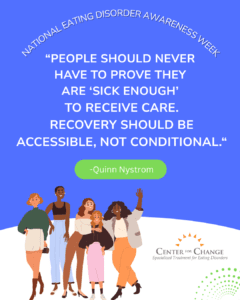
Committing to change means building systems where people do not have to prove they are “sick enough” to receive care.
It means ensuring providers are trained to recognize eating disorders across all body types. It means improving insurance parity. It means creating communities where worth is not tied to appearance or productivity.
Every Body Belongs
Recovery taught me something simple but transformative: belonging is not conditional.
Not on body size. Not on perfection. Not on meeting someone else’s expectations.
If you are struggling, your experience is valid. If you are supporting someone you love, your advocacy matters. If you are working toward change…in healthcare, families, or communities, your voice matters.
Because healing expands when stigma shrinks. Care improves when voices are heard. And true recovery becomes possible when we believe, and build a world that reflects this truth:
 Call Us Today


