


Please note that this is an Archived article and may contain content that is out of date. The use of she/her/hers pronouns in some articles is not intended to be exclusionary. Eating disorders can affect people of all genders, ages, races, religions, ethnicities, sexual orientations, body shapes, and weights.
Written by a former patient & registered nurse
For anyone considering treatment—even with fear. If you’re scared, but still reading.
If you are reading this and feeling scared about coming to treatment, I want you to know that your fear makes sense. I felt it too.
As someone who has been both a patient and a nurse, I understand how frightening it can feel to ask for help—especially if you’ve been struggling for a long time, or if this isn’t your first time seeking care. I also know how easy it can be, in healthcare, for repeated illness to be met with fatigue or emotional distance rather than compassion. That was something I feared deeply when I returned to treatment.
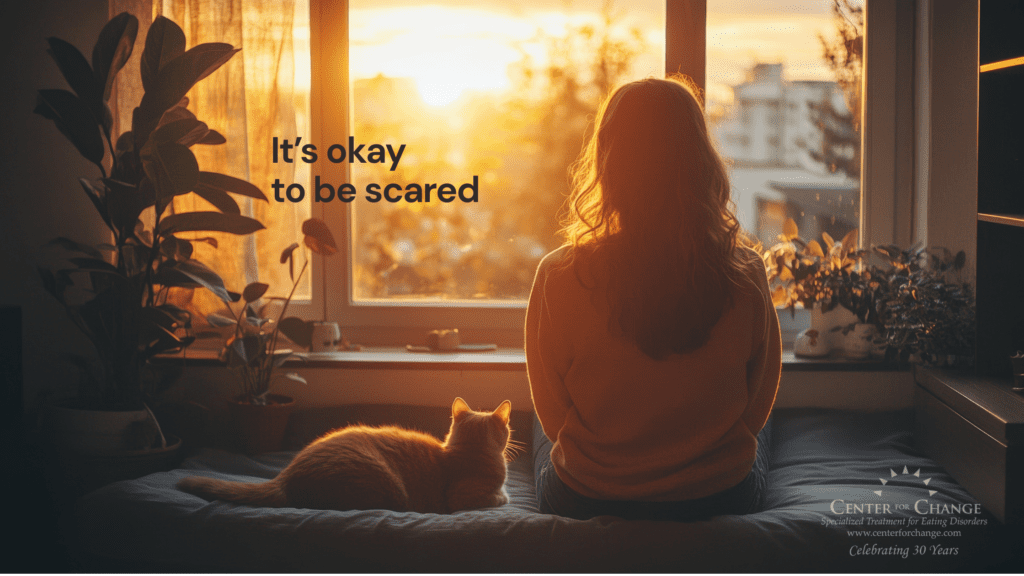
That fear was never realized at the Center for Change.
Over the years, I received care there at multiple levels—during both recovery and relapse. Each time I walked back through the doors, I was terrified. I worried I would be judged, seen as a failure, or viewed as “too much.” What I experienced instead was care that was deeply engaged and deeply human.
In the moment, it can feel like you are being seen through a harsh lens—even when that isn’t what’s happening. Eating disorders are built on shame, and that shame can distort how care is experienced. With time and healing, I can now clearly see that my experience at the Center for Change was something very different. If frustration was ever present—or if I perceived it—it was never rooted in disappointment. It came from the staff knowing that more was possible for me. They saw a life beyond my illness—even during the darkest moments, when I was convinced there wasn’t one. They carried belief and hope for me until I could carry it again on my own.
If you are afraid to come to treatment, please hear this: struggling does not make you a burden, and relapse does not make you a failure. You will not be written off. You will be met exactly where you are—with care, dignity, and people who understand how hard this is. You do not have to feel ready or hopeful. You do not even have to believe recovery is possible yet. The staff will believe it for you until you can.
Fear does not disqualify you from care. Care is meant for people exactly where they are—including when they are afraid.
The Center for Change played a profound role in saving my life and helping me reclaim it. Their compassion changed how I see myself and laid the foundation for the solid recovery I live in today.
With care and hope,
Former patient & registered nurse
 Call Us Today


